Career Opportunity: Join us as an independent mortgage broker today! There are no co-working space fees, sinking funds, subscription fees, or entrance fees. Contact us at 9157 0157.

Guide to Getting a Private Property Loan

Buying a private property in Singapore, whether a condominium, apartment, or landed home, requires careful financial planning and understanding of your loan options. This guide walks you through the essentials of securing a private property loan, including eligibility, loan limits, downpayment requirements, and key steps to approval.
private property loan

Understanding Your Financing Options

When purchasing a private property in Singapore, bank loans are the only financing option available. HDB concessionary loans are strictly for public housing (HDB) and cannot be used for private properties.

Bank loans offer various fixed and floating rate packages, allowing borrowers to choose based on their financial goals and risk preferences. Each bank may have different eligibility criteria, interest structures, and lock-in periods, so comparing multiple offers helps you secure the most competitive and suitable package.

Types of Rates and Their Pros and Cons

Private property loans generally come in two main types, fixed-rate and floating-rate packages. Each has its advantages depending on your financial goals and market outlook.

Fixed Rate

(For completed properties only)

Interest rate remains constant for a set lock in period (usually 2 to 3 years).

Floating Rate

(SORA pegged)

Interest rate fluctuates with the Singapore Overnight Rate Average (SORA).

Recommendation

Fixed Rate suited for: Homeowners who value repayment stability and want to lock in rates during a volatile market.

Floating Rate suited for: Borrowers who are comfortable with rate movements and want flexibility to take advantage of future rate declines.

Eligibility Criteria for Getting a Private Property Loan

Understand what banks and MAS require when you apply for a private property loan in Singapore.
CriterionWhat is assessedKey rules/limits
Total Debt Servicing Ratio (TDSR)Measures how much of your income goes to all monthly debt obligations, including the new loan. (including car loans, student loans, etc.)Max 55% of gross monthly income
Mortgage Servicing Ratio (MSR)Does not apply to private property purchase.
Loan-to-Value (LTV) RatioThe portion of the property price/value you can borrow.Up to 75% (with 25% down payment)
Borrower Age & Loan TenureThe combined age of borrower(s) and length of loan must meet regulatory/ bank limits.Loan tenure for private property is up to 30 years or until the borrower turns 65. It can be extended to 35 years or until age 75, but the LTV drops to 55% and the minimum cash downpayment increases to 10%.
Income & Credit AssessmentBank checks fixed income, variable income (with “haircut”), employment history, credit score.All variable income (such as bonuses, rentals) may be discounted (only 70% counted) when computing your gross monthly income for TDSR.
Property Remaining Lease / Ownership ConditionsThe remaining lease of the property and previous ownership of private property may affect eligibility.If property has short remaining lease the LTV may be lowered. Also prior private property ownership may affect some loan types.

How Much Loan Can I Get? (LTV and TDSR Explained)

The loan amount you can obtain for a private property depends mainly on two key financial regulations set by the Monetary Authority of Singapore (MAS):

  • Loan-to-Value (LTV) — limits how much of your property’s value can be financed through a bank loan.

  • Total Debt Servicing Ratio (TDSR) — ensures your total monthly debt obligations stay within a safe portion of your income.

First Housing Loan

private property loan
Remarks
Standard for most first-time private property buyers.

Second Housing Loan

private property loan
Remarks
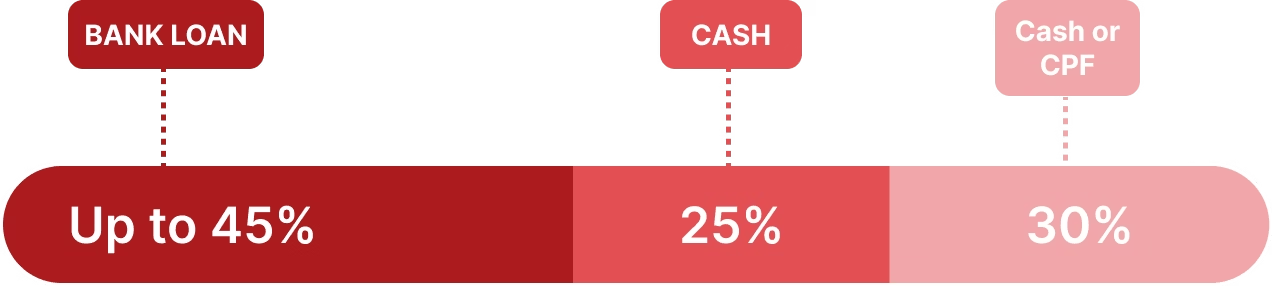
Applies if you have an existing outstanding home loan. (Current 1 + New)

Third or More Housing Loan

private property loan
Remarks
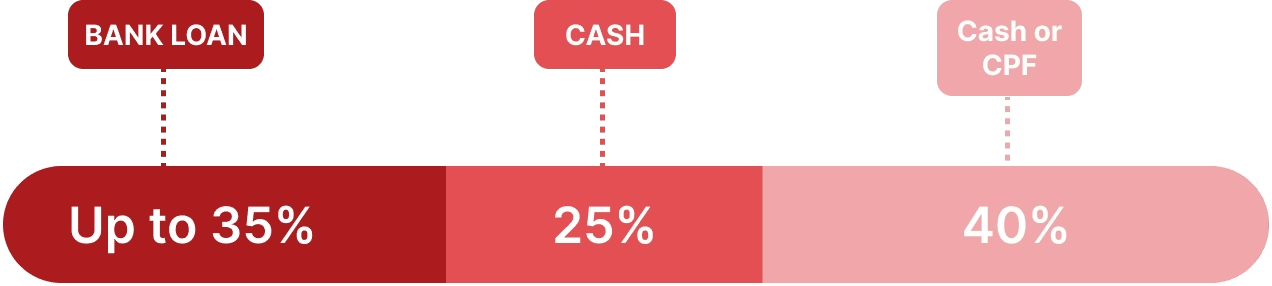
With existing multiple home loans (Current 2 + New).

Total Debt Servicing Ratio (TDSR)

TDSR limit
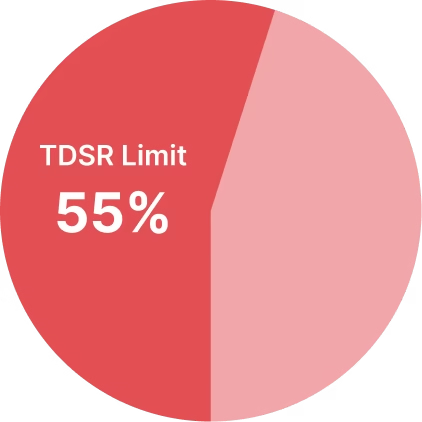
The TDSR framework caps your total monthly debt repayments at 55% of your gross monthly income. This includes your housing loan, car loan, credit card instalments, and any personal loans.

💡 Example: Calculating Your Eligible Loan Amount

Let’s assume you are purchasing a condominium priced at S$1,000,000. You earn S$10,000 per month, and this is your first housing loan.


1️⃣ LTV Calculation
Maximum loan = 75% × S$1,000,000 = S$750,000


2️⃣ TDSR Calculation
Maximum total monthly debt allowed = 55% × S$10,000 = S$5,500

Assuming the bank uses a 4% stress test interest rate and a 25-year tenure, your maximum monthly instalment for the housing loan is about S$3,960 for a S$750,000 loan.


✅ This is below the S$5,500 TDSR limit, so the full S$750,000 is eligible.


However, if your income were lower (say S$7,000 per month), the maximum monthly debt allowed would be S$3,850, which means your eligible loan amount would be slightly reduced to around S$730,000 to stay within the TDSR cap.

Downpayment and Other Costs to Consider

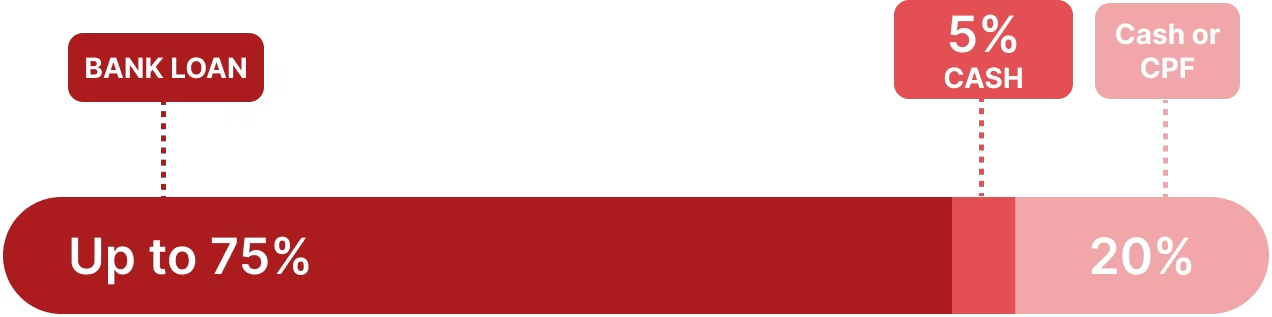
Private property purchases require a minimum 25 percent down payment based on the property’s price or valuation, whichever is lower.

  • 5% must be in cash
  • The remaining 20% can be paid using CPF OA savings and/or cash

💡 Example: For a S$1.5 million condominium, the minimum downpayment is S$375,000. Of this, at least S$75,000 must be paid in cash, while the remaining S$300,000 can be from CPF or additional cash.

Other costs to factor in:

  • Legal fees (Around S$2,500 – S$3,000 for private property purchase with a bank-appointed law firm)

  • Valuation fees (Typically start from $150, depending on the property type, value of the property, and the bank)

  • Stamp duties (Varies by property value and buyer profile, check it here)

  • Fire insurance

  • Property tax

Use of CPF Funds

CPF Ordinary Account (OA) savings can be used for:

  • Downpayment (up to 20 percent)
  • Legal and stamp duty fees
  • Monthly instalments


However, the CPF usage limit depends on the property’s remaining lease and the buyer’s age. Always ensure your CPF funds can sustain repayments comfortably over the long term.

cpf property loan

Steps to Secure Your Private Property Loan

Here’s the step by step process to obtain your private property loan efficiently
refinance home loan

Financial Assessment and Loan Consultation

We begin with a detailed review of your financial profile, including income, debts, and existing loan commitments. This allows us to determine your borrowing capacity based on TDSR (Total Debt Servicing Ratio) and LTV (Loan-to-Value) limits.

refinance home loan

Obtain an In-Principle Approval (IPA)

Next, we assist you in securing an In-Principle Approval (IPA) from one or more banks. The IPA gives you an indicative loan amount and interest rate based on your financial documents and credit profile. Having an IPA before committing to a property (signing the Option to Purchase) gives you clarity on your financing limits and confidence when making an offer.

refinance home loan

Compare and Select the Best Private Property Loan Package

Once you’ve placed the Option Fee or deposit to secure your property, it’s time to start comparing and locking in your private property loan package. At IQrate, we help you review and compare fixed-rate and floating-rate home loan packages across all major banks.

Our advisors highlight key details such as lock-in period, repayment schedule, refinancing flexibility, and bank subsidies so you can make a confident, well-informed choice.

We also perform real-time rate comparisons through our internal system to ensure you secure the most competitive loan package available after your deposit has been placed.

refinance home loan

Prepare and Submit Your Documents

Once you’ve chosen your preferred bank, we guide you through the documentation stage. This includes preparing:

  • NRIC (front and back)
  • Payslips and income tax statements
  • CPF contribution history (12 months)
  • Latest bank statements
  • Option to Purchase (OTP) or Sales & Purchase Agreement

We verify all documents for completeness and accuracy before submission to prevent delays and ensure a smooth approval process. Some banks allow e-submission through SingPass MyInfo for faster processing.

refinance home loan

Bank Credit Assessment and Letter of Offer (LO)

Once approved, the bank issues a Letter of Offer (LO) detailing your approved loan amount, tenure, interest rate, and conditions. We go through the LO together with you, explaining all terms, fees, and repayment details to ensure you fully understand your commitment before signing.

refinance home loan

Appointing Your Law Firm

Once you’ve accepted the Letter of Offer, we’ll assist you in appointing a law firm from the bank’s approved panel to handle all conveyancing and mortgage registration matters. The lawyer will work closely with the bank and the seller’s lawyer to review the Sale and Purchase documents, prepare and execute the mortgage paperwork, and ensure all stamp duties and registrations are completed. They will also confirm the property valuation with the bank and coordinate the legal completion timeline, while we keep you updated at every stage until disbursement.

refinance home loan

Completion and Loan Disbursement

At the final stage, your appointed law firm coordinates with the bank to disburse the loan funds to the seller. This marks the official completion of your purchase. You’ll then begin your monthly repayments under the new loan terms and we’ll continue to assist you with ongoing rate reviews or future refinancing opportunities to help you save more in the long run.

Frequently Asked Questions

Everything You Need to Know

What is a fixed rate?

Fixed Rate refers to an interest rate that remains constant for a specific period, typically ranging from 1 to 5 years. This means the borrower’s monthly mortgage payments stay the same throughout the fixed term, regardless of market interest rate fluctuations. It offers borrowers predictability and stability in managing their finances. However, if market rates fall, borrowers will not benefit from the lower rates during the fixed-rate period.

SORA (Singapore Overnight Rate Average) represents the average interest rate at which banks in Singapore lend and borrow funds from one another on an overnight basis. It is calculated based on the volume-weighted average of all actual borrowing transactions conducted between 8:00 am and 6:15 pm in the interbank market.

Refinancing means switching your existing home loan to a new package, either with the same bank or a different bank, usually to enjoy lower interest rates or better terms. By refinancing, homeowners can reduce monthly repayments and save on overall loan costs.

A Lock-in Period is the minimum time you must stay with your current home loan package before refinancing or fully repaying it. Typically lasting 2 to 5 years, it ensures the bank recovers its administrative and promotional costs. If you choose to refinance early, a penalty of about 1.5% of the outstanding loan amount may apply.

Tip: If you’re planning to sell your property during this period, do let our Mortgage Broker know! We can help you find a home loan package that offers a full 100% penalty waiver upon sale of your property.


Yes. Firstly, ensure that you are not within any lock-in period or that your loan package allows for partial redemption during the lock-in period. You can use your CPF (Central Provident Fund) Ordinary Account (OA) savings to repay your home loan in part or in full before maturity. The steps differ depending on whether your loan is with HDB or a bank.

For HDB loans:

  • Ensure you have sufficient funds in your CPF OA and check your maximum CPF usage limit.

  • Apply online via the HDB website or submit a CPF withdrawal form at any HDB branch.

  • Processing usually takes about three working days for online submissions and three to five working days for branch submissions.

For bank loans:

  • First, obtain approval from your bank.

  • Confirm you have enough CPF OA savings and review your usage limits through the Homeownership dashboard.

  • Submit your application online using Singpass. If you intend to fully redeem your loan, attach the bank’s redemption statement and your lawyer’s legal bill (if applicable).

  • Processing typically takes around five working days.

An IPA is a bank’s conditional approval of your home loan, based on your income, credit profile, and debt obligations. It gives you clarity on your borrowing power.

On average, you can expect the processing time for private property home loan applications to be from a few days to several weeks (varies across all banks). At IQrate, we closely coordinate with banks and law firms to ensure your application moves quickly and smoothly, so you can focus on completing your property purchase with confidence.

Bank Loan

  • You can borrow up to 75% of the property’s value or purchase price (whichever is lower) for a bank loan, with 5% payable in cash and the remaining 20% payable in cash or your CPF OA savings.


HDB Loan

  • You can borrow up to 75% of the purchase price for new flats. For resale flats, it is 75% of the resale price or market valuation (whichever is lower), at least 25% of the purchase price, which can be paid in full using your CPF Ordinary Account (OA), with cash, or a combination of both.

Yes, several banks in Singapore offer subsidies to refinance home loans. For HDB properties, if your outstanding loan amount exceeds S$300,000, many banks provide full subsidies to cover legal and valuation fees. For private properties, banks typically offer cash subsidies to offset refinancing expenses when your remaining loan balance is above S$500,000.

Do note that these subsidies generally come with a three-year clawback period. This means if you switch banks or fully redeem your loan within that period, the subsidies may need to be repaid. While there are occasional exceptions, they are uncommon and should be reviewed carefully before proceeding.

Applying for a Home Loan

Why Choose Us for Your Home Loan?

Fast, Simple, and Hassle-Free

We’ll do the heavy lifting on your home loan search. Our Mortgage Broker will explain everything in clear terms and get in touch personally, giving you more time for life’s important moments.

Your Savings, Our Commitment

We compare home loan packages across all banks in Singapore to ensure you get the best possible deal, saving you time, money, and stress.

Free Service. No Fees. No Pressure.

Our service is free for you! We’re paid a standard referral fee by banks so our advice stays independent and focused on getting you the best deal.

Best Home Loan Rates Guaranteed

Compare from all banks and financial institutions

Gain access to exclusive mortgage rates and benefits from all our partnered banks and financial institutions. We provide unbiased advice with no obligation and no hidden fees, ensuring you get the best mortgage options tailored to your needs. Our goal is to help you find the perfect loan with complete transparency and the lowest possible rates.