


Everything homeowners need to know about SORA, fixed rates, floating rates & choosing the right mortgage.
By IQrate Mortgage Specialists
Introduction
Over the past few years, many homeowners in Singapore have experienced one of the fastest increases in mortgage interest rates in history.
Some borrowers who were paying below 1.20% p.a. during the pandemic suddenly found themselves paying more than 4.00% p.a. within just two years.
Monthly mortgage instalments increased by hundreds or even thousands of dollars, leaving many homeowners asking the same questions:
What exactly is SORA?
Why did my mortgage become so expensive?
Should I choose a Fixed or Floating Rate?
Will interest rates continue to fall?
If you’ve ever asked these questions, you’re not alone.
Understanding how mortgage interest rates work is no longer optional; it has become one of the most important financial decisions every homeowner needs to make.
Whether you’re purchasing your first home, refinancing an existing mortgage, upgrading from an HDB home loan Singapore package to a private property mortgage Singapore package, or simply reviewing your current home loan, understanding SORA can potentially save you thousands of dollars over the life of your mortgage. In this guide, IQrate explains everything you need to know about SORA home loan interest rates in Singapore, how banks determine mortgage interest rates, what causes rates to rise and fall, and how to choose the most suitable financing strategy
Quick Summary
If you only remember five things about SORA home loan interest rates in Singapore, remember these:
✅ SORA is Singapore’s official benchmark interest rate for most floating rate packages home loans.
✅ Unlike SIBOR, SORA is based on actual overnight interbank transactions rather than banks’ quoted rates.
✅ SORA generally moves according to interest rate expectations, banking system liquidity, and global monetary conditions.
✅ Choosing between a Fixed Rate package and Floating Rate package should depend on your financial objectives rather than simply whichever package has the lowest advertised interest rate.
✅ Reviewing your mortgage regularly could potentially save you thousands of dollars over your loan tenure.
Myth vs Fact
| Myth | Fact |
| Banks decide SORA. | SORA is published daily by the Monetary Authority of Singapore (MAS) based on actual overnight unsecured interbank transactions. |
| Fixed Rates packages are always safer. | Fixed Rates packages provide certainty but may not always result in lower borrowing costs over the long term. |
| Floating Rates packages are always risky. | Floating Rates packages can outperform Fixed Rates during declining interest rate environments. |
| All SORA packages are the same. | Different banks offer different spreads, lock-in periods, repricing options, and incentives. |
| The lowest interest rate is always the best package. | Overall loan features and future flexibility are just as important as the headline rate. |
What is SORA?
SORA stands for Singapore Overnight Rate Average. It is Singapore’s benchmark interest rate, often called the MAS SORA benchmark, and it is published every business day by MAS.
Unlike the previous SIBOR benchmark, SORA is calculated based on actual overnight unsecured borrowing transactions between banks in Singapore.
Because it is transaction-based, SORA is generally regarded as a more robust and transparent benchmark than SIBOR. Today, almost all new floating rate packages home loans in Singapore are pegged to Compounded 1-Month or 3-Month SORA.
Why Did Singapore Replace SIBOR?
For many years, SIBOR was the benchmark used for most home loans, and understanding SIBOR vs SORA is key to understanding today’s mortgage market.
However, SIBOR was based largely on the rates that banks submitted rather than completed transactions.
Following global benchmark reforms after the Global Financial Crisis, regulators around the world encouraged the adoption of benchmark rates that are based on actual market transactions.
Singapore therefore transitioned from SIBOR to SORA, providing a benchmark that reflects real overnight interbank borrowing activity.
How is SORA Calculated?
The process behind the compounded SORA rate is relatively straightforward.
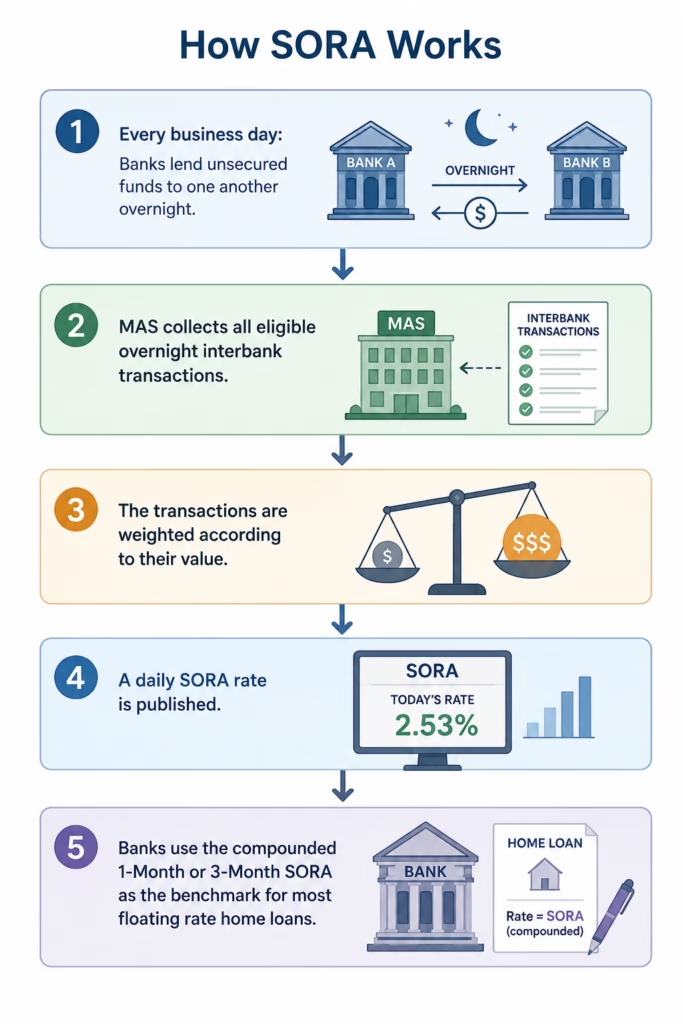
Because mortgage instalments are typically based on the compounded rate rather than the daily rate, borrowers generally experience smoother changes instead of sharp day-to-day fluctuations.
Why Do Different Banks Offer Different SORA Interest Rates?
This is one of the most common questions homeowners ask.
Many homeowners assume that if every bank uses the same SORA benchmark, every bank should charge the same mortgage interest rate.
In reality, the floating-rate mortgage consists of two components:
1M/3M Compounded SORA + Bank Spread = Final Mortgage Interest Rate
Example A
3M SORA 1.10% + Bank A Spread 0.20% = 1.30%
Example B
3M SORA 1.10% + Bank B Spread 0.25% = 1.35%
Bank spread mortgage Singapore pricing often differs because of
- Different funding costs between banks
- Overall market liquidity
- Customer acquisition strategy
- Risk appetite
- Relationship banking
- Seasonal promotional campaigns to arrive at full-year targets/projections
What Causes SORA to Move?
This is one of the most commonly misunderstood topics. Many people assume MAS simply decides the SORA rate.
In reality, SORA is determined by market conditions.
Several factors influence SORA, including:
Global Interest Rate Environment When major central banks tighten monetary policy, global funding costs generally increase, which can influence Singapore’s interest rates.
Banking System Liquidity
The amount of Singapore dollar liquidity within the banking system affects overnight borrowing costs.
Higher liquidity generally leads to lower overnight borrowing costs, while tighter liquidity may result in higher overnight rates.
Market Expectations
Financial markets constantly price in expectations of future monetary policy.
These expectations can influence funding costs even before official policy changes occur.
Economic Conditions
Inflation, economic growth and financial market conditions all contribute to the overall interest rate environment
Does SORA Follow US Interest Rates?
Not directly.
However, Singapore’s financial system is closely connected to global capital markets.
When US interest rates rise significantly, Singapore’s interest rates often move in the same direction because funding costs become more expensive globally.
Likewise, when the US begins easing monetary policy, SORA may also trend lower over time, although the timing and magnitude may differ.
Why Don’t Fixed Mortgage Rates Move Exactly Like SORA?
People think SORA dropped…Therefore fixed rates should immediately drop. Actually…
Banks look at
- Future interest rate expectations
- Swap market
- Funding cost
- Hedging cost
not today’s SORA.
Simple illustration
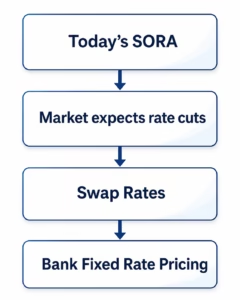
This explains why fixed rates packages sometimes remain elevated even when floating rates start easing.
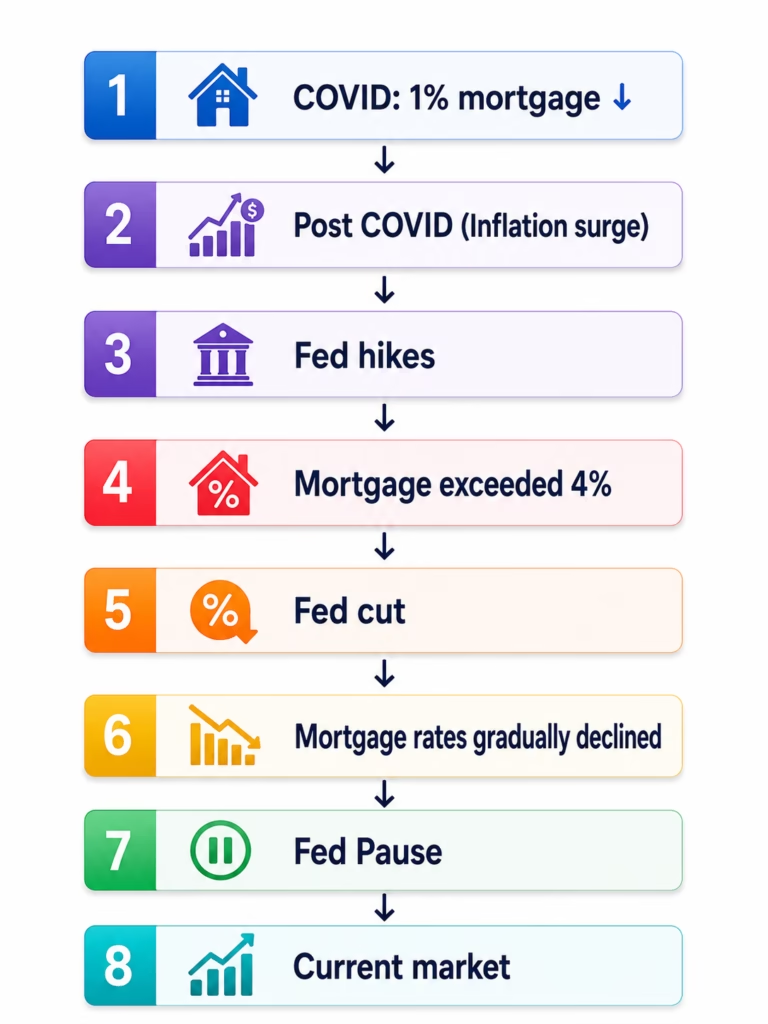
Why Did Mortgage Rates Rise So Sharply Between 2022 and 2023?
During the COVID-19 pandemic, interest rates reached historic lows.
Many homeowners secured fixed-rate mortgages below 1.50% p.a. As inflation accelerated globally, central banks tightened monetary policy aggressively by increasing rates.
Funding costs increased significantly, resulting in much higher mortgage interest rates.
For homeowners on a floating-rate package, monthly repayments increased substantially.
This period highlighted the importance of understanding the interest-rate cycle that Singapore borrowers face, rather than focusing solely on today’s promotional mortgage rate.
Fixed Rate vs Floating Rate
When comparing a fixed-rate home loan singapore package against a floating rate home loan Singapore package, there is no universal answer.
The right choice depends on your circumstances.
Home Loan Fixed Rate
Advantages
✔ Predictable monthly repayments
✔ Protection against rising interest rates
✔ Easier household budgeting
Considerations
• May be higher than Floating Rates packages during declining rate environments
• Usually comes with a lock-in period
Floating Rate
Advantages
✔ Potentially lower borrowing costs when interest rates fall
✔ Tends to be lower from the onset compared to fixed rate packages
Considerations
• Monthly instalments can fluctuate
• Borrowers should be comfortable with interest rate movements
When Does IQrate Usually Recommend Fixed Rates?
Normally when
✓ Rates are expected to rise
✓ Homeowner prefers budgeting certainty
✓ Lower risk tolerance
✓ First-time buyer
✓ Tight monthly cashflow
When Does IQrate Usually Recommend Floating Rates?
Usually when
✓ Rate-cut cycle
✓ Higher risk tolerance
✓ Investors who expect interest rates to decline over time
Which Homeowners May Prefer Fixed Rates?
Given the home loan interest rate Singapore 2026 outlook, a Fixed Rate may be suitable for borrowers who:
- Prefer certainty over monthly repayments.
- Have tight cash flow and wish to minimise payment fluctuations.
- Expect interest rates to rise.
Which Homeowners May Prefer Floating Rates?
A Floating Rate housing loan Singapore package may be suitable for borrowers who:
- Believe interest rates may decline.
- Are comfortable with changing monthly instalments.
- Intend to refinance if market conditions become favourable.
- Preferring an opportunity to save on interest cost over payment certainty.
Should You Always Choose the Lowest Interest Rate?
Not necessarily.
Many borrowers doing a home loan comparison in Singapore focus only on the headline interest rate.
However, several other factors should also be considered:
- Lock-in period
- Legal subsidy clawback
- Free conversion options aka repricing options
- Partial repayment flexibility
- Refinancing costs
- Future property plans – example looking to sell or upgrade in near future
Sometimes a slightly higher interest rate may provide greater flexibility and lower overall financing costs.
Example
| Bank A | Bank B |
| 1.40% (Fixed) | 1.60% (Fixed) |
| 2-years lock in | 3-years lock in |
| Free conversion after 2 years | Free conversion after 1 year |
| Legal clawback within 3 years | No legal fee clawback after 3 years |
| Flexible partial repayment |
Result: Bank B may allow you to save more after making partial redemption.
Can You Predict Future Interest Rates?
No one can predict interest rates with certainty.
Even economists, investment banks and central banks regularly revise their forecasts.
Rather than trying to time the market perfectly, homeowners should choose a mortgage package — factoring in the mortgage lock-in period Singapore banks typically impose — that aligns with their financial objectives and risk tolerance.
Common Mistakes Homeowners Make
❌ Choosing solely based on the lowest advertised interest rate.
❌ Ignoring lock-in periods.
❌ Not reviewing their mortgage after the lock-in expires.
❌ Assuming all SORA packages are identical.
❌ Waiting until interest rates rise before exploring refinancing options.
❌ Not seeking independent mortgage advice before committing to a property purchase.
❌ Relying solely on a single bank referral instead of an independent mortgage broker Singapore homeowners can compare alternative options through.
💡 IQrate Market Insight
Many homeowners ask whether they should refinance immediately whenever interest rates fall. Here are a few home loan refinancing tips to keep in mind.
The answer depends on:
- Remaining lock-in
- Subsidy/cash rebate clawback
- Legal fee, valuation fee
- Loan balance
- Predicted holding period on property
- Future plans
- Sometimes, waiting before refinancing may produce a better overall financial outcome.
Frequently Asked Questions
How often does SORA change?
The SORA rate today Singapore banks quote is published every business day by MAS. However, most floating-rate home loans reference the compounded 1-Month or 3-Month SORA, which helps smooth out short-term daily fluctuations. Interest rate or instalment will revise on monthly or quarterly basis.
Can SORA become negative?
While theoretically possible, Singapore has not experienced sustained negative SORA rates. The interest rate environment depends on broader economic and financial conditions.
Can I switch from Floating Rate to Fixed Rate?
Yes. Many banks offer repricing or refinancing options, although eligibility and costs depend on your existing loan package; whether you have a free conversion option or are within a lock-in period without free conversion option.
Should I refinance every two years?
Not necessarily. The decision should consider interest rates, legal costs, subsidies, clawbacks, lock-in periods and your future plans, which is why mortgage refinancing Singapore homeowners undertake deserves a case-by-case review rather than a fixed two-year rule.
IQrate Mortgage Tip
💡 Don’t judge a home loan by its headline interest rate alone.
The most suitable mortgage package isn’t always the one with the lowest advertised rate. Factors such as future flexibility, lock-in period, repricing options, legal subsidies and your long-term property plans can have a much greater impact on your total financing cost over the life of the loan
Final Thoughts
One Mortgage Doesn’t Fit Everyone!
Two homeowners may receive completely different mortgage recommendations despite having identical incomes.
Why?
Because every homeowner has different
- Risk appetite
- Future plans
- Property holding period
- Refinancing opportunities
- Cashflow objectives
At IQrate, we believe choosing the best home loan Singapore 2026 has to offer isn’t simply about securing the lowest interest rate.
It’s about selecting the financing strategy that best supports your long-term financial goals.
How IQrate Can Help
As an IQrate mortgage advisory, we do more than compare mortgage interest rates.
We help homeowners understand how banks structure their mortgage packages, assess whether refinancing or repricing is suitable, and identify financing solutions that align with their goals.
Whether you’re buying your first property, upgrading to a larger home, or reviewing your existing mortgage, IQrate can help you navigate Singapore’s evolving interest rate environment, including the latest mortgage interest rate forecast and Singapore trends, with greater confidence.
Why Trust IQrate?
Curate, Smart Rates!
At IQrate, we believe that every homeowner deserves transparent, unbiased and professional mortgage loan advice. Our role is not simply to help you find a low interest rate, but to curate a mortgage solution that best fits your financial goals, lifestyle, and future plans.
Here’s why homeowners trust IQrate:
✅ Unbiased Mortgage Advice
Our recommendations are based on your financing needs and objectives, not on commission differences or sales incentives.
✅ No Advisory Fees
Our mortgage advisory service is completely free. We do not charge homeowners any consultation or advisory fees.
✅ Equal Marketing Fee Across Participating Banks
Every participating bank pays IQrate the same marketing fee for a successful home loan origination.
This means our recommendations are not influenced by which bank you choose. Instead, we focus on helping you identify the mortgage package that best suits your individual needs.
✅ No Additional Cost to You
Our services come at no additional cost to homeowners. As mortgage specialists, we actively monitor participating banks’ latest promotional home loan packages, helping ensure that you don’t miss out on competitive financing options that may not always be readily known to every borrower. Beyond comparing interest rates, we also help you evaluate the overall suitability of each mortgage package based on your individual needs.
Our Commitment
At IQrate, “Curate, Smart Rates!” is more than a tagline. It’s our promise.
We believe that choosing the right home loan isn’t about chasing the lowest advertised interest rate. It’s about understanding your financial objectives, comparing financing options objectively, and selecting a mortgage solution that supports your long-term goals.
Our mission is simple:
To empower every homeowner with transparent, unbiased mortgage advice and help them make confident financing decisions through carefully curated smart mortgage solutions.