

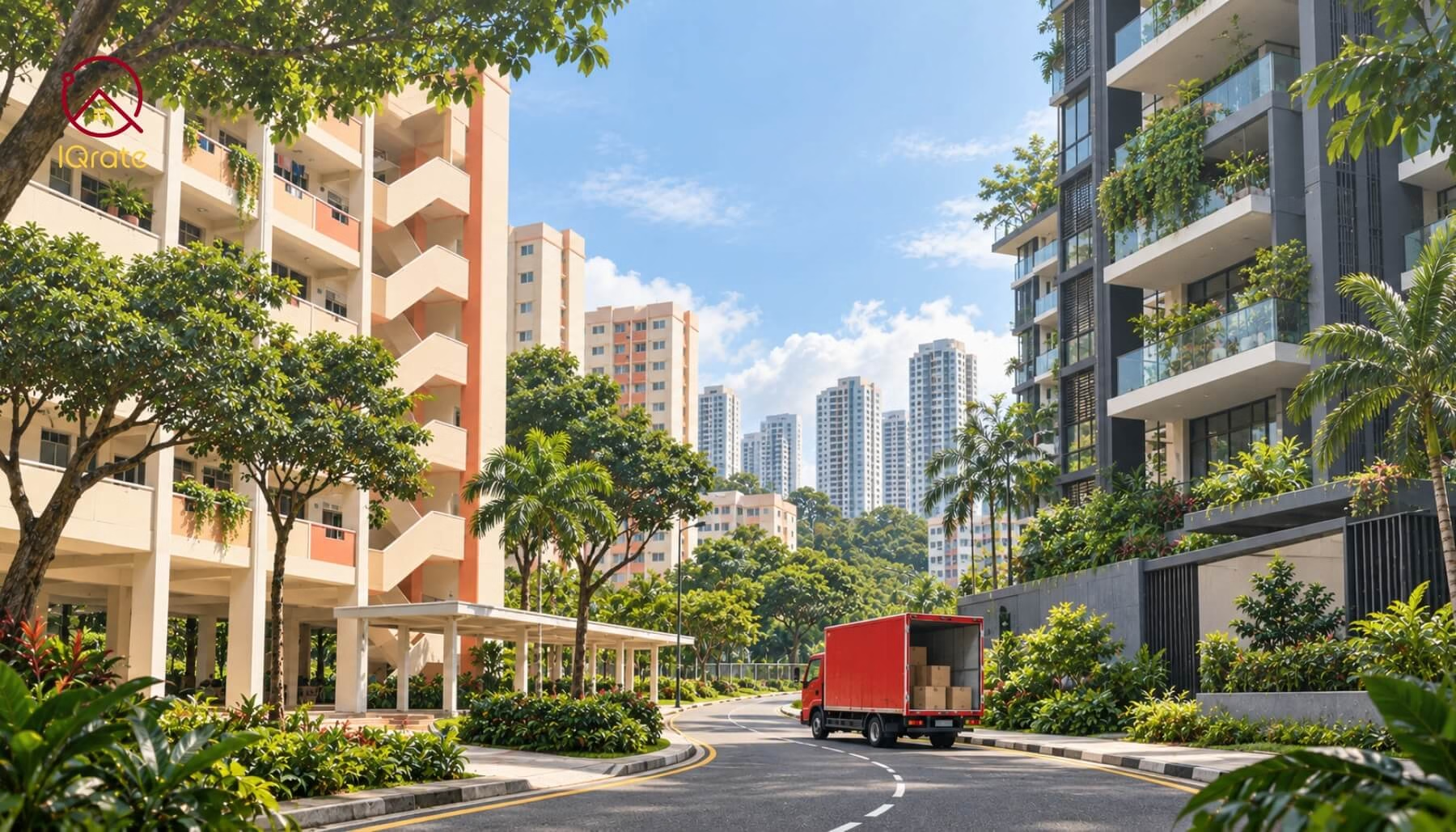
Thinking of upgrading from an HDB flat to a condominium, or moving to a bigger home? Before you start house hunting, check how much money you can actually use from your current property and how much you can comfortably borrow for the next one.
Upgrading your home in Singapore can be an exciting step. Your family may need more space, you may want a better location, or your income may have improved since you bought your first property.
But an upgrade involves more than choosing a bigger home and comparing mortgage rates. You must also account for your outstanding home loan, CPF refund, stamp duties, selling expenses, and the timing of both transactions.
The key question is not just “Can I afford the new property?”
It is “Can I afford the entire move without stretching my finances?”
In this guide, IQrate explains how to work out your available funds, compare your financing options, and avoid common upgrading mistakes.
Quick Answer: What Should You Check Before Upgrading?
Before committing to your next home, work through these five checks:
- Estimate your net sale proceeds. Deduct your outstanding mortgage, required CPF refund, and selling expenses from your expected sale price.
- Find out how much CPF you can reuse. CPF refunded from your sale may be available for your next property, subject to CPF rules and your age.
- Get your new loan eligibility assessed. Your income, debts, age, loan tenure, and any existing housing loan can affect how much a bank offers.
- Plan whether to sell or buy first. The order can affect your cash flow, downpayment, and potential Additional Buyer’s Stamp Duty (ABSD).
- Keep a cash buffer. Include renovation, moving expenses, temporary housing if needed, and unexpected costs.
1. Calculate How Much Cash You Will Get From Selling Your Current Home
A common mistake is assuming the selling price of your property is the amount you can put towards your next home.
For example, if your property sells for S$1.5 million, that does not mean you will receive S$1.5 million in cash.
You generally need to settle your outstanding housing loan, refund the CPF savings used for the property with accrued interest, and pay selling-related expenses.
Example: Selling a property with an outstanding mortgage
| Item | Illustrative amount |
| Property selling price | $1,500,000 |
| Outstanding mortgage | −$500,000 |
| Required CPF refund (including accrued interest) | −$300,000 |
| Estimated cash proceeds before selling expenses | $700,000 |
This is a simplified example. Actual proceeds depend on your sale price, mortgage redemption amount, CPF refund, and transaction expenses.
The important figure is your net cash proceeds, not the headline selling price. Ask your bank for the estimated loan redemption amount and check your CPF Home ownership dashboard for your required housing refund.
2. Understand Your CPF Refund When Upgrading
If you used CPF Ordinary Account (OA) savings to buy or pay for your current home, you will generally need to refund the amount used plus accrued interest when you sell.
Accrued interest is the interest your CPF savings would have earned if that money had remained in your CPF account. It is not a penalty charged by the bank.
In the earlier example, the $300,000 CPF refund does not simply disappear. It is returned to your CPF accounts under the applicable rules. Depending on your circumstances, part of the refunded savings may be available for your next home purchase.
If you are 55 or older, the CPF refund may first be used to meet your required retirement savings before any balance remains available in your OA. This is why your age and CPF position matter when planning an upgrade.
If your home sells at market value but the sale proceeds are insufficient to cover the full CPF refund after paying the outstanding loan, CPF Board generally does not require you to top up the shortfall in cash. Specific conditions apply.
IQrate tip: Work out cash proceeds and CPF savings available for the next purchase separately. They are not the same pool of funds, and both affect your downpayment plan.
3. Work Out the True Cost of Your Next Property
Suppose you want to upgrade to a condominium costing S$1.8 million.
Before deciding whether it is affordable, consider more than the difference between the new purchase price and your expected sale proceeds.
Your upfront and ongoing costs may include:
- Downpayment, including any minimum cash portion required by the bank
- Buyer’s Stamp Duty (BSD) and ABSD, if applicable
- Legal, valuation, and other purchase-related fees
- Outstanding loan redemption costs or penalties, if applicable
- Renovation, furniture, and moving expenses
- Mortgage instalments, maintenance fees, property tax, and insurance
- Temporary accommodation or overlapping home loan payments, depending on your timeline
The cash you receive from selling your home may not be available on the same day you must pay for the new property. Map out when each payment is due, not just the total amount.
A home upgrade can look affordable on paper but still cause a cash shortfall if the payment dates do not line up.
4. Should You Sell Your Property First or Buy First?
The order of your sale and purchase can make a major difference to your finances.
Sell First, Then Buy
Selling your current home first can make it easier to calculate your available cash and CPF funds. You may also avoid having two housing loans outstanding at the same time.
However, you could need temporary accommodation, and you may face pressure to find a suitable replacement home once your sale is completed.
Buy First, Then Sell
Buying first may allow you to secure a property you like before your existing home is sold.
But you may have to manage two properties and two financial commitments for a period. Your existing housing loan can also affect the amount of financing available for the new purchase. ABSD may apply depending on your ownership and buyer profile.
| Consideration | Sell first | Buy first |
| Available sale proceeds | Easier to confirm before buying | May not be available for the new downpayment |
| Overlapping housing commitments | Usually easier to avoid | May occur |
| Timing pressure | May need temporary housing | May need to sell within a deadline |
| Loan and stamp duty implications | Depends on the completed sale and purchase structure | Existing loan and ownership may affect financing and ABSD |
Neither route is automatically better. The right choice depends on how much cash you have, the type of properties involved, and whether you can meet the necessary payment and sale timelines.
If you plan to use temporary financing or a bridging loan, ask the bank about eligibility, costs, and when the funds must be repaid. Do not assume temporary financing will always be available.
5. How Your Existing Mortgage Affects Your New Loan
Your bank will reassess your ability to borrow when you apply for a new housing loan. Approval for your first home loan does not guarantee approval for your next one.
Banks generally consider your current income, existing monthly debts, credit profile, age, and intended loan tenure.
Total Debt Servicing Ratio (TDSR)
For most bank housing loans, the Total Debt Servicing Ratio (TDSR) generally limits total monthly debt repayments to 55% of gross monthly income, subject to the applicable rules and bank assessment.
This includes existing home loans, car loans, personal loans, and other debt commitments. Banks also assess mortgage affordability using applicable interest-rate assumptions rather than simply today’s advertised promotional rate.
Loan-to-Value (LTV) Limits
The Loan-to-Value (LTV) limit determines how much of a property’s value a bank may finance.
Under the standard regulatory conditions, an eligible borrower with no outstanding housing loan may qualify for financing of up to 75% of the property’s value or purchase price (whichever the bank uses under applicable rules). If the borrower still has one outstanding housing loan, the standard LTV cap is generally 45%. Tighter caps apply for longer tenures or loans extending beyond certain age thresholds. Banks may also lend less following their credit assessment.
This is one reason the timing of selling your existing property can be important. Do not assume you can obtain the same loan amount while your current mortgage is still outstanding.
For personalised figures, review your new loan eligibility before you commit to the Option to Purchase (OTP).
6. Watch Out for Stamp Duty and HDB Rules
Upgrading may involve costs or restrictions that did not apply when you bought your first home.
Buyer’s Stamp Duty (BSD)
BSD is generally payable when you purchase property in Singapore. The amount depends on the purchase price or market value, whichever is higher, under the prevailing rules.
Additional Buyer’s Stamp Duty (ABSD)
ABSD depends on factors including your residency status, how many residential properties you own, and how the new property is purchased.
Some eligible married couples buying a replacement home may qualify for ABSD remission or a refund if they meet strict conditions, including the deadline for selling their first property. For example, under the standard spouse remission rules, the first property generally must be sold within six months of purchasing the completed replacement property, or within the prescribed period tied to TOP/CSC for an uncompleted replacement property. The exact conditions must be checked with IRAS.
Do not assume ABSD will automatically be waived because you intend to sell your current home later.
HDB Minimum Occupation Period (MOP)
If you are upgrading from an HDB flat, check whether you have fulfilled its Minimum Occupation Period (MOP) and other applicable HDB conditions before selling or buying private residential property. The MOP differs by flat type and classification.
Also check whether Seller’s Stamp Duty (SSD) might apply to the property you intend to sell, particularly if it was purchased recently.
7. A Longer Mortgage Tenure Does Not Make the Property Cheaper
When comparing properties, many buyers look mainly at the monthly mortgage instalment.
A longer loan tenure can reduce your required monthly repayment. That may make a more expensive home feel easier to afford.
However, if the loan amount and interest rate stay the same, a longer repayment period generally means more total interest paid over the life of the loan.
Before selecting your loan tenure, consider:
- Whether monthly repayments remain comfortable if interest rates rise
- How much total interest you could pay over the loan period
- Whether you have enough cash left for family expenses and emergencies
- How close you are to retirement
- Whether the package allows partial repayments and what fees may apply
Your goal should be a loan that you can manage comfortably, not simply the lowest monthly instalment shown by a calculator.
8. How Much Should You Spend on Your Next Home?
Instead of starting with the highest property price a bank might allow, work backwards from your finances.
Step 1: Estimate your net sale proceeds. Include loan redemption, CPF refund, and selling expenses.
Step 2: Check your available CPF and cash. Separate what is immediately spendable from funds that are restricted or only available after your sale completes.
Step 3: Confirm your new housing loan eligibility. Account for your income, existing loans, age, tenure, and the timing of your sale.
Step 4: Add all purchase and moving costs. Include BSD, possible ABSD, legal fees, renovation, and temporary housing.
Step 5: Keep enough emergency savings. Decide how much cash you want to retain after the move and test whether repayments remain manageable if circumstances change.
The most expensive property you qualify for is not necessarily the one that best fits your household.
9. Home Upgrade Checklist for Singapore Homeowners
Before committing to your next property, make sure you can answer these questions:
- Have I checked whether I am eligible to sell or upgrade my current property?
- Do I know my outstanding mortgage and any early redemption conditions?
- Have I checked my CPF principal used and accrued interest?
- Do I know my estimated net cash proceeds from the sale?
- Have I checked how much CPF can be used towards my next property?
- Have I compared selling first against buying first?
- Have I confirmed potential BSD, ABSD, and SSD obligations?
- Have I obtained an assessment of my new home loan eligibility?
- Have I budgeted for renovation, moving, and overlapping costs?
- Will I still have enough cash after moving into the new home?
Frequently Asked Questions About Upgrading Your Home
Can I use the CPF refunded from my current home to buy another property?
Generally, yes, CPF savings refunded to your OA may be used for an eligible next property, subject to CPF housing rules, available balance, and withdrawal limits. If you are 55 or older, some refund money may first need to go towards your retirement savings.
Should I sell my HDB flat before buying a condominium?
It depends on your finances and circumstances. Selling first may make your available funds clearer and reduce the risk of overlapping loan commitments. Buying first may create more flexibility in choosing a home but can affect your loan eligibility and ABSD position. You must also satisfy applicable HDB rules, including the MOP.
Will I need to pay ABSD when upgrading?
You may. ABSD depends on your ownership and buyer profile at the time of purchase. Certain married couples may qualify for remission or a refund when replacing their home, but the eligibility criteria and sale deadlines are strict. Confirm your situation with IRAS or a qualified professional before purchasing.
How much can I borrow if I still have an existing mortgage?
Your borrowing limit may be lower while an existing housing loan remains outstanding. Banks consider LTV rules, TDSR, your income and debts, and their own credit assessment. Request an updated loan eligibility assessment instead of assuming your first-home borrowing limit still applies.
What happens to my CPF accrued interest when I sell?
The CPF principal you used for the property, together with accrued interest, generally needs to be refunded from the sale proceeds under CPF rules. This is a refund into your own CPF savings, not a bank penalty, but it can reduce the cash you receive from the sale.
Is upgrading to a bigger home always a good financial move?
Not necessarily. More space and a better location may improve your family’s lifestyle, but the new mortgage, stamp duties, upkeep, and other expenses must remain comfortable. A successful upgrade should improve your living situation without putting your long-term finances under unnecessary pressure.
Final Thoughts: Upgrade Your Home Without Stretching Your Finances
Upgrading your home in Singapore is more than a property decision. It is also a mortgage, CPF, and cash-flow decision.
Before buying, understand how much you will receive from selling your current home, how much CPF can be reused, how much the new bank loan will cost, and how much cash you will still have afterwards.
The right upgrade is not necessarily the biggest home you can buy. It is the home that meets your needs while allowing you to live comfortably.
How IQrate Can Help
At IQrate, our mortgage brokers help Singapore homeowners compare home loan packages from different banks, assess new loan eligibility, and plan financing when moving to another property.
If you are thinking about upgrading from an HDB flat to a condominium or moving to a larger private home, speak to an IQrate Mortgage Specialist for a complimentary, no-obligation consultation before making your next commitment.